

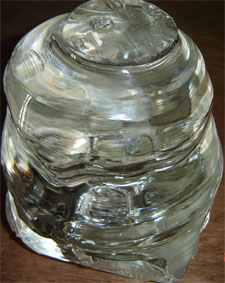
 Due to the hardest of the oxide crystals, Sapphire has very good of optical and physical properties that makes it the best choice for a variety of demanding applications. Sapphire maintains its strength even at high temperatures. It has good thermal properties, excellent electrical and dielectric properties and is resistant to chemical attack. These properties encourage the use of Sapphire in aggressive environments where reliability, optical transmission or strength is required.
 blank, Sapphire ball and Sapphire rod with high quality and low cost. Careful selection of raw materials and strictly quality control at every stage of growth, ensure the best
| Crystal Structure: | Hexagonal System |
| Lattice: | a=4.785A, c=12.991A |
| Density: | 3.98g/cm 3 |
| Transmission Range | 0.15-5.5µm |
| Melting Point: | 2042°C |
| Specific Heat: | 0.418W×s/g/k |
| Thermal Conductivity: | 25.12W/m/k(@100°C) |
| Thermal Shock Resistance: | 790W/m |
| Thermal Expansion Coefficient: | 5.8´10 -6 /K |
| dn/dt (@633nm) | 13´10 -6 /K |
| Mohs Hardness: | 9 |
| Refractive Index(n o ): | 1.83(0.26mm), 1.76(0.63mm), 1.58(5.57mm) |
| Diameter: | +0.0, -0.1mm |
| Thickness: | ±0.1mm |
| Flatness: | l/4 |
| Parallelism: | better than 1' |
| Perpendicularity: | better than 5' |
| Scratch-Dig: | 40/20 per MIL-O-13830A |
| Wavefront Distortion: | l /4 per inch @1064nm |