

 |
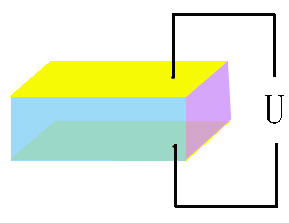 |
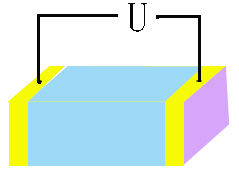
| longitudinal E-O modulation | transverse E-O modulation |
| Crystals | GTR-KTP | BBO | LiNbO3 | DKDP | RTP |
| Crystal stru. | Orthorhombic | Trigonal, | Trigonal | Tetragonal | Orthorhombic, |
| Space group | Pna21 | R3c | R3C | Pna21 | |
| Point group | mm2 | 3m | 42m | Mm2 | |
| Cell parameters | a=6.404Å, b=10.616Å, c=12.814Å, Z=8 |
a = b = 12.532 Å c = 12.717Å Z=6 |
a=5.148Å , c=13.863Å |
a = 12.96 Å b= 10.56 Å c =6.49 Å |
|
| Melt point | 1172 ℃ | 1095+ 5 ℃ | 1253 ℃ | ~ 1000 ℃ | |
| Curie point | 925+ 5 ℃ | 1140 ℃ | ~810 ℃ | ||
| Mohs hardness | 5 | 4 | 5 | 2.5 | ~5 |
| Density | 3.01 g/cm3 | 3.85 g/cm3 | 4.64 g/cm3 | 2.355 g/cm3 | 3.6 g/cm3 |
| Thermal expansion coefficients: (/k) |
a,4 x 10-6 ; c, 36 x 10-6 |
//a2.0x10-6 //c16.7x10-6 |
1.9x10⁻⁵ ⊥z 4.4x10⁻⁵ // z |
a1=1.01x10⁻⁶ , a2=1.37x10⁻⁶, a3=-4.17x10⁻⁶ |
|
| Hygroscopic susceptibility |
No | A Little | No | Yes | No |
| Thermal conductivity W/m/K |
13 | c, 1.2; //c, 1.6 |
38 | 1.9 ⊥z 2.1 // z |
|
| Therm-optic coefficients: (dn/dT, / C,) |
X:1.1x10⁻⁵ Y:1.3x10⁻⁵ Z:1.6x10⁻⁵ |
o: -9.3 x 10⁻⁶ e:-16.6 x 10⁻⁶ |
o: -0.874x10⁻⁶ e: 39.073x10⁻⁶ |
| Crystals | KTP | BBO | LiNbO3 | DKDP | RTP |
| V 4x4x20mm | ~1400V | ~4800V | ~950V | ~3400V | ~1400V |
| Contrast Ratio | 20dB | 40dB | 25dB | 30dB | 20dB |
| Capacitance | 5 pF | <2pF | 20 pF | 7~10pF | 6pF |
| Electrical Resistivity | 1011-1012 W.cm |
1012-1013 W.cm |
109-1010 W.cm |
1011–1012 W.cm |
|
| Transmitting range(nm): | 350 nm-4500 | 189-3500 | 420nm-5200 | 200-1600 | 350~4500 |
| Electro-optic coefficients: |
13 =9.5 23 =15.7 33 =36.3 42 =7.3 51 =9.3 |
Y11 = 2.7 Y22, Y31 < 0.1 Y11 |
YT33= 32, YT31 =10 , YS31=8.6 YT22 = 6.8, YS22=3.4 |
r41=8.8pm/V r63=25pm/V |
Y13=10.6 Y23=12.5 Y33=38.5 |
| Ab.coef.@1064nm | <50ppm | <1000ppm | <1000ppm | <1000ppm | <500ppm |
| Index @ 1064nm |
nx=1.7377 ny=1.7453 nz=1.8297 |
ne = 1.5425, no = 1.6551 |
ne = 2.156, no = 2.232 |
no=1.4948,ne =1.4554 |
nx=1.7424 ny=1.8211 nz=1.7905 |
| damage threshold (10 ns ): |
8J/cm^2 | 13J/cm^2 | 2J/cm^2 | 10J/cm^2 | 8J/cm^2 |