

Current position: Index > Technology support >
Frequency Conversion Phase-matching Conversion Efficiency How to Handle A NLO Crystal Optimum Crystal Size and Cut |
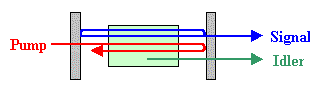 splits one high-frequency photon (pumping wavelength, lp) into two low-frequency photons (signal, ls, and idler wavelength, li). If two mirrors are added to from a cavity as shown in fig. 7, an Optical Parametric Oscillator (OPO) is established. For a fixed pump wavelength, an infinite number of sigal and idler wavelengths can be generated by tilting a crystal. Therefore, OPO is an excellent source for generating wide tunable range coherent radiation. BBO, KTP, LBO and LINbO3 are good crystal for OPO and Optical Parametic Amplifier (OPA)Applications.
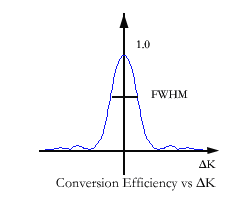 IN order to obtain high conversion efficiency, the phase vectors of input beams and generated beams have to be matched:
| Laser Parameters | Crystal Parameters |
| NLO Process | Phase-Matching Type and Angle |
| Power or Energy | Damage Threshold, Deff |
| Divergence | Acceptance |
| Bandwidth | Spectral Acceptance |
| Beam Size | Crystal Size, Walk-off Angle |
| Pulse Width | Group Velocity Mismatching |
| Repetition Rate | Damage Threshold |
| Environment | Temperature Acceptance, Moisture |
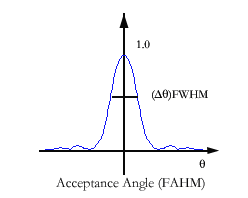 If a laser light propagates in the direction with angle Δq to phase matching direction, the conversion efficiency will reduce dramatically. We define the acceptance angle (Δq) as full angle at half maximum (FAHM), where q=0 deg. is phase-matching direction. For example, the acceptance angle of BBO for type I frequency doubling of Nd:YAG at 1064nm is about 1mrad-cm. therefore, if a Nd:YAG laser has beam divergence of 3mrad for frequency-doubling, over half of the input power is useless. In this case, LBO may be better because of its larger acceptance angle, about 8 mrad-cm. For NCMP, the acceptance angle is normally much bigger than that for CPM, for example, 52 mrad-cm(1/2) for type I NCPM LBO.
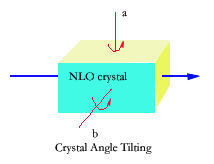 Angle Tilting